

Strange & Deadly
Strange & Deadly is in stores!
This is not a drill. IT IS HERE! Strange & Deadly is in stores today.
This is both my first independently published book and my adult debut!
After seventeen years in the young adult (and traditional publishing) space, I’m releasing my very first book that’s actually labeled adult1 and I’m doing it totally solo!
If you want to learn more about how this whole self-publishing process has gone, check out this AMA Part 1 video or read the transcript! I spent almost an entire hour discussing my behind-the-scenes steps, reasonings, and (in true Sooz fashion) fears for the entire journey.
So, please consider supporting me? 🙏
I almost never, ever ask for things from you guys. I know it’s annoying to get inundated with buy links or pre-order requests! You’re here for my writing advice, and you don’t want to know about my books.
That’s fine! It’s why I split my book and writing stuff back in 2022, so as not to keep bothering the writers who followed me.
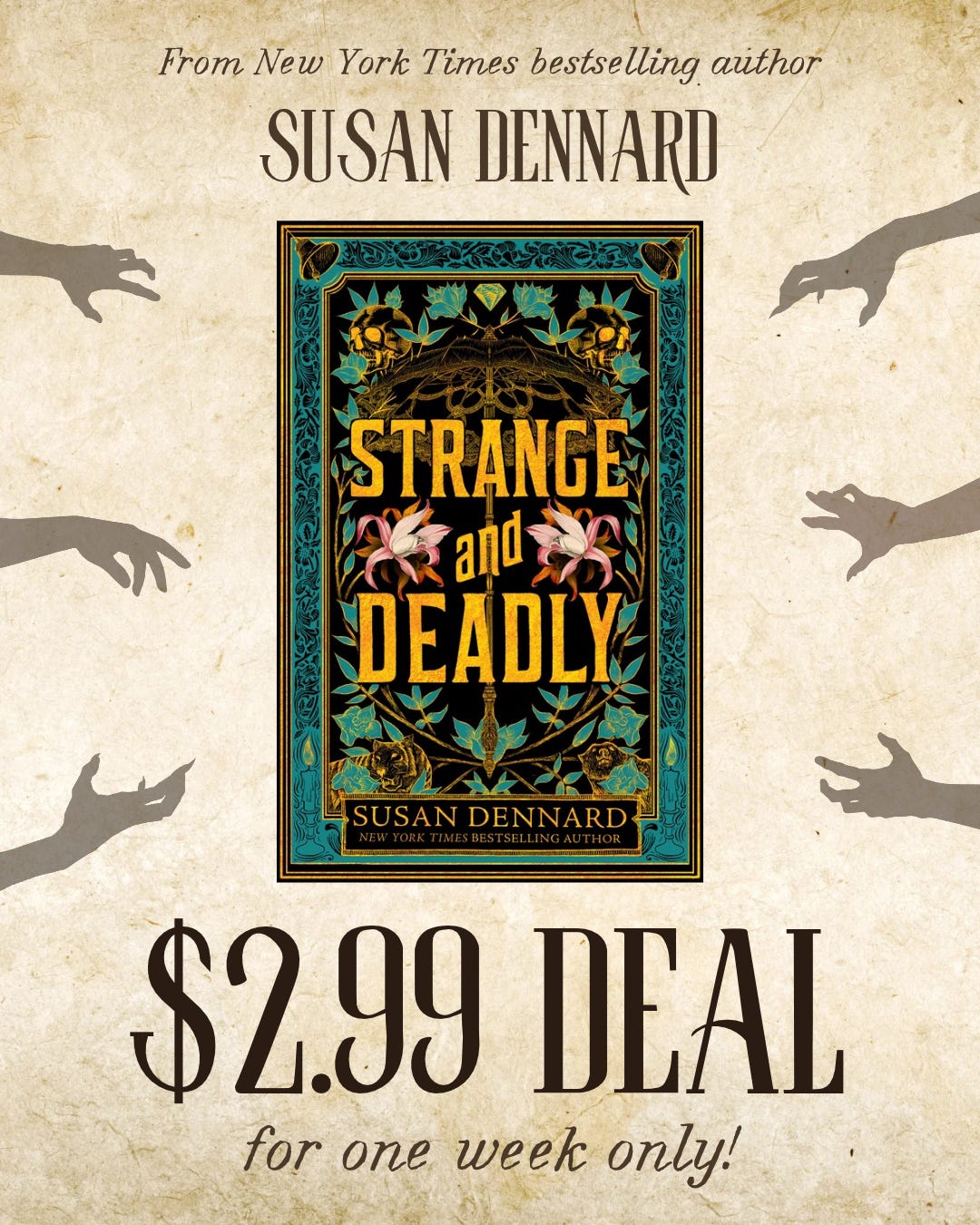
But today I’m please-please-please asking if you’ll buy the ebook while it’s only $2.99.
Again, I never do this kind of thing in the Misfits & Daydreamers newsletter! Sure, I’ll occasionally plop in a pre-order link or cross-post a cover reveal because my publisher asks me to, but otherwise I try to keep the M&D Substack clear of book stuff.
So please—just this once!—would you consider buying a copy of Strange & Deadly?
I’m obviously anxious about how this whole indie thing is going to go for me. Will I make my money back? Will people enjoy this book? Will the whole endeavor BACKFIRE SPECTACULARLY, LEAVING SOOZ-SHAPED PIECES OF MY SOUL SPLATTERED ACROSS THE INTERNET?
We shall find out soon enough. 🙈
But there are twenty thousand of you receiving this newsletter! If even a fraction of you buy the ebook during this launch week, it would make an absolutely enormous difference in how the algorithms pick up my book and how readers discover me moving forward.
And look! To make it worth your while I’ve even made an absolutely, monstrously, huge post below with nitty-gritty craft detail just for you. And this is only part 1! The newsletter got to be so long, I ran out of space and had to split it in two.
So please, please, please. 🥹🙏 Buy the book?
I’ll make it even easier for you and give you a list of the major retailer links right here. All you have to do is click on a link, then click on a buy button. 🥹🙏🥹🙏🥹🙏
The paperback is also available now, so if you’d rather get that, that’s fine too! I will be thrilled either way. 😅
Okay, I’ll stop begging and being annoying now. I promise!! So, onto that aforementioned nitty-gritty craft stuff…
A Tale of Two Chapters, Part 1
I spent entirely too much time this past Saturday trying to figure out how I wanted to approach a side-by-side comparison of Something Strange and Deadly (written in 2009, published in 2012) and Strange & Deadly, my adult debut (written in 2026, published in 2026).
But what I found was it’s like trying to compare an apple to an orange. Sure, they have similar shapes, and yeah, they’re both fruits, but that’s pretty much where the similarities end.
Apples and oranges don’t taste the same. They don’t look the same. And the texture inside and out is completely different.
And actually, once I thought about that, I realized it was the perfect way to tackle the volume of differences between what—on the surface—look like they are very similar scenes.
So let’s break it down below. We’ll start with the shape—oranges and apples are round—and then we’ll zoom in to assess where the texture, juice, color, etc. have changed.
The Story Shape
At a cursory glance, the opening chapters of the 2012 and 2026 books have the same broad shape. Their beats are as follows:
Eleanor is waiting on her brother at the train station.
Her brother doesn’t arrive.
A decrepit corpse arrives instead.
Chaos ensues.
Eleanor goes inside a telegraph office.
And there she discovers a message from her brother.
On the surface, that looks a lot alike that overlaps, right? I mean, really, how can two scenes with that much in common actually be any different?
Oh, my sweet summer children.
They can be so different.
And this is why authors say all the time that it doesn’t matter if two people have the same idea, because how they execute the idea won’t be the same.
Or, in this case, how 2009 Susan executed her idea is nothing like how 2026 Susan did.
But wait, why don’t you see for yourself?
Look, I’d rather have no one ever read the opening chapter of the 2012 book. I mean, I wrote it in 2009! It was literally the first book I ever finished.
But, alas. To fully feel and study the differences between the 2012 version and the 2026 version, you’re going to have to read my raw, beginner words.
Start by reading the 2026 version of Chapter One, though. Please.
This is partly for my own ego’s sake, but mostly I suggest this because I think you’ll have an easier time comparing and contrasting the chapters if you go backward in time, rather than forward. With the 2026 version fresh in your mind, you’ll be able to look at the 2012 version and say, Oh goodness, she wasn’t joking.
Beat-by-beat Comparison
In case you didn’t read the chapters—or in case you’re like me and a visual learner—I’ve made a detailed table breaking it all down.
Take a look to see how the more specific beats are and are NOT the same between the two scenes.
(Reading this on a mobile? Open the post on a computer or tablet to see a larger version of the table!)
If you look at the table, the first two rows only apply to the 2026 version. And those two rows actually cover the first 303 words.
In those opening paragraphs, I set up:
Eleanor’s voice (sassy)
the story’s main stakes (a hapless brother who keeps missing trains and asking for money)
and Eleanor’s unique view on the world (Shakespeare! Murder most foul!).
The 2012 opening had none of that. Instead, I opened in medias res with a woman screaming (row three).
Full disclosure here: I never liked the 2012 opening—it was something my very first editor wanted. I was a newbie author then, who was still figuring out what she liked, so I didn’t push back.
But even back in my earliest author days, opening like that wasn’t my way. And 2026 Sooz definitely knows better. I always start with character voice now. (Which isn’t to say you can’t start like I did in the 2012 version. Only that I don’t personally like it for my books.)
And this is the perfect segue into…
From character comes plot (not the other way around)
The reason I always open with a line that comes from my character’s voice is that it allows me, the author, to set up everything that will come afterward.
Sure, my 2012 opening might let you know what kind of book you’re getting in terms of zombies and chaos, but it offers nothing about the person you’re going to sit with for the next 400 pages.
Nor does that 2012 opening line really give you the overall “vibes” of what’s ahead, and I think both of those pieces are vital for setting up an engaging tale.
You’re welcome to disagree, of course! And I won’t argue with you. This is my subjective preference, though, so it’s what I enjoy reading and writing.
On top of that, it’s a vital requirement for my intuitive drafting process. My stories literally unspool based on what I see as my character at any given moment. So how on earth can I see a scene if I’m not fully immersed in the head that’s telling the story?
Here are a few opening lines from assorted books of mine over the last decade, and I think they each one sets up well the voice and tone of what’s follow.
Everything had gone horribly wrong.
There were advantages to being a dead man.
They say that spring never comes to the forest by Hemlock Falls.
Freddie Gellar hadn’t meant to get half the student body of Fortin Prep arrested.
There is nothing so vexing as a person who has decided to miss an appointment.
That last line is, of course, from the 2026 Strange & Deadly. And it sets up immediately that Eleanor feels something we can all relate to.
It is annoying when someone stands you up!
Plus, we also see she has a vaguely historic, somewhat “elevated” style of speaking. That might be to your taste, or it might not be. But you know right off the bat what you’re getting.
We’re also left asking, as readers, Well, who missed an appointment and why didn’t they show? That’s a good hook to keep people at least moving on to the next paragraph.
And in those subsequent paragraphs (about 300 words in total), Eleanor answers and gives us a full display of her character.
We learn she’s sassy, we learn she’s exhausted by her brother who keeps standing her up and requesting money, and we learn she’s somewhat selfless—but also kind of resentful that she has to be selfless at all.
So when things implode after those 300 words, we’ve got a good handle on who she is and why we ought to care about her.
That, in turn, means that when she makes the choices she makes in the rest of the chapter, I don’t have to explain to you why.
The plot now comes from the character.
We understand perfectly why, when a kid shows up in the chaos screaming her head off, that of course Eleanor has to sweep her up to help. That’s what she does!
But she’ll also be annoyed about it. Especially when circumstances escalate around her and the child, forcing her to make new decisions that aren’t necessarily the wisest but are now the only thing available.
That’s pretty much the entire thesis of the book in a single scene.
Eleanor is, as a character, incapable of leaving people to fend for themselves—even when she really, really should. It’s a virtue and a flaw rolled into one. And the whole book is about to show you what that means for her at scale.
So literally every plot point that follows the first 300 words of the book is a result of this one characteristic I introduce right away.
2012 Eleanor was a blank slate
The 2012 opening had none of the annoyed, selfless Eleanor 2.0 that the 2026 book has. So even if I’d possessed the writing chops to foreshadow the entire book in the opening scene, I wouldn’t have been able to do so since there was nothing to foreshadow!
Eleanor 1.0 just didn’t have much happening in the way of real character development.
She had enough dimension for me to get a book deal, so don’t get me wrong. She’s not a complete piece of cardboard. BUT—and it’s a big but—I was a beginner writer. I told you she liked buttered toast and Shakespeare, and I thought I was showing this by sprinkling in a few examples of those characteristics. (Show vs. tell again! More on this to come in part 2!)
But every plot point that happened was because I’d made an outline, then I’d found reasons for Eleanor 1.0 to go do those things on the outline RATHER than seeing what she would actually choose based on what came before.
You can see this plot-dictates-character issue right on the page. It’s evident in the sheer number of times I have to explain to the reader why Eleanor 1.0 does things. Not just in chapter one, but throughout the book! I would spend multiple sentences or even paragraphs explaining the why of an action because that why wasn’t clearly baked in and obvious.
In fact, here’s an example of this from the 2012 Chapter One:
My eyes caught on a crumpled sheet of paper nearby. I snatched it up, but it was only a newspaper page. The headline read: “Walking Dead Still Rise in Laurel Hill Cemetery.” I pushed the paper into my pocket to read later. I’d ignored the recent Dead reports, thinking they wouldn’t affect me. Foolish—the Dead were more than just specters to frighten unruly children. The Dead were very real.
Really? Eleanor 1.0 had just ignored the papers and believed the Dead were only from children’s tales? Then why did she open the chapter saying she’d heard reports of the Dead escaping their graves? And for that matter, why was there a Dead alarm in the train depot and how did she know what it sounds like?
Also, her solution to her ignorance is to…grab a conveniently placed newsletter ?
Nah.
I fixed this issue by simply not having Eleanor in 2026 find a newspaper. (Instead, she proactively goes after a newspaper in a later chapter—and I’ll get into the proactive vs. reactive character stuff below!)
All of this is to say that if you have to constantly explain and justify why a character is doing what they do, then you’re telling the story instead of showing it.
And this rule doesn’t only apply to main characters! Throughout the original 2012 book, all my characters did things because I’d written on my outline that now was the moment it needed to happen.
This was especially true with backstory info dumps. Characters were pouring out their backstories like a BioWare dialogue.2 Zero subtlety.
Note: If you often get external feedback from readers that says, Wait, why did Gary Stew do this? This doesn’t feel believable to me, then this “show vs. tell” piece of motivation might be your problem. You might very well have written Gary Stew doing things for the sake of the plot instead of for the sake of his needs, wants, and motivations.3
Character agency and consequences
Another major difference between the two books, 2012 vs. 2026, is that Eleanor 1.0 was very reactive. Eleanor 2.0 is much more proactive.
This doesn’t mean reacting is always a bad thing in a story. There will be plenty of instances in a book (and should be) when a character is reacting to the antagonist or the world.
But in a truly proactive story, a lot of the reactive beat will come from consequences that spring out of previous proactive decisions.
So in other words, even when Eleanor 1.0 seemed to be “proactive” in Something Strange & Deadly, her choices don’t lead to ripple effects that would change entire trajectory of the story if I tweak a single early scene.4
Let’s break this down in the context of the two opening chapters—because again, on the surface, Eleanor 1.0 seems proactive(ish). But was she really driving the story? Or was she simply making in-scene decisions that look proactive in the moment but don’t truly change the story’s trajectory?
2012 version:
Eleanor 1.0 chooses, out of self-preservation, to go into the telegraph office and wait out the chaos at the train depot.
→ She then decides to search a stack of telegrams for one from her brother. (How convenient!)
→ How even more convenient, she finds a newspaper right there explaining that the Dead are walking in Philadelphia. Yoink! She’ll read it later to educate herself, she tells us.
→ Then when one such Dead arrives, Eleanor gets scared. Lots of reacting happens here.
In fact, from here out, she stops being proactive, and all she does is react.
→ She trips in her own skirts trying to flee, then generally panics.
→ The corpse drops a handwritten message.
→ To her horror, she sees it’s from her brother. Oh no! He must have been taken by a necromancer!
On the surface Eleanor 1.0 seems to make choices: she goes into the telegraph office, and looks through some telegrams—and this does make her available and alone when the walking corpse arrives. That’s a consequence, right?
But this beat didn’t need to happen in the telegraph office. It could have happened anywhere at the depot and still worked because the corpse would have still delivered the message to her—and it still would have been a handwritten note from her brother.
In other words, we see some proactive choices, but we don’t see any consequences.
2026 version:
I still wanted Eleanor to run into that corpse for the new 2026 book! It was the opening premise of the original novel, and I was determined to stick to ths.
But I also knew Eleanor had to have real character reasons this time for being in the wrong place at the wrong time. On top of that, I wanted to make sure there were real, longterm consequence to her being in the ticket office versus outside out of it.
So here are the new beats:
Eleanor 2.0 hears a girl screaming and scoops the child up from the chaos.
→ They’re getting stampeded, so Eleanor shoves them into the relative safety of an empty telegraph office.
This is a CONSEQUENCE of her decision to grab the kid, since she can’t handle the stampede while also protecting the girl.
→ The girl scrambles off Eleanor and hides under a desk. DRAT.
This is another CONSEQUENCE of Eleanor’s decision. She’s stuck now.
→ While Eleanor is trying to coax the kid out, the corpse arrives.
Now, rather than react, Eleanor continues to be proactive—and in a way that shows her character. She distracts the child by being silly.
→ The corpse drops a piece of paper, and Eleanor continues her distraction ploy by telling the tale of The Tempest.
Again, proactive! And also still a consequence of saving that kid in the first place.
This is also Eleanor’s character lens in action with Shakespeare love! (More on that lens in part 2!)
→ The corpse leaves, but by then, the kid has warmed up to Eleanor, so Eleanor is more focused on the kid than whatever the corpse was doing.
→ Eleanor finally notices what the corpse dropped: and to her confusion, it’s a telegram from her brother.
The telegram piece is vital because it means Eleanor 2.0 can dismiss the message! If the corpse had cornered her outside the office, then nope. Obviously it came from her brother by way of corpse.
However, since she was in the telegraph office and the paper landed on all the other telegrams, she’s able to assume she mixed up which paper the corpse dropped.
There will be a critical consequences from this moving forward!
The rest of both books continue in similar fashions to their above beats. Eleanor 1.0 continues to frequently do things for the plot rather than for her internal compass, and worse, she’s often told what to do by the Spirit-Hunters rather than coming up with steps to execute on her own.
Eleanor 2.0 meanwhile, continues to make decisions—many of them terrible—that drive her ever closer toward her goal while stirring up heaps of messy consequences to deal with along the way.
Coming up next!
I have two more aspects I want to discuss about these opening chapters (and the books over all). Think of them as the differences in texture and taste between our apple and orange!
We’ve compared shape, so next time, we’ll zoom in to the sentence-level and discuss:
How I use what I call “character lenses and superpowers” in my writing now.
How I fully understand the phrase “show vs. tell” in action, dialogue, and interiority.
Alas, I’m out of space here. But I promise I’ll share them soon, along with the second half of the AMA! And I hope this first part has been illustrative and educational.
Feel free to ask questions below if you have them! Better to get answers now and make sure it’s all clear before we continue onward.
Now I’m off to celebrate my ADULT DEBUT’S RELEASE DAY!!! 🎉🎉🎉
Again, I’d be so grateful if you’d buy a copy of Strange & Deadly! And remember: it’s only $2.99 for a week, so now is the perfect time to support me! 🥰
💚 - Sooz
Okay, so the Witchlands was also written for adults. But I sold it during the heyday of “let’s make everything YA.” So it’s not labeled as adult. At least not in the US, but it is in most other countries where I sold it.
RIP. I was feeling sad-ish, but not heartbroken…Until that ME5 trailer leaked. Now I’m just crushed over what might have been. Effing EA.
It’s important to note too, however, that sometimes people will give you this feedback—saying they didn’t find a character choice believable—but it will be for purely subjective reasons. Because they, the reader, wouldn’t do X in a situation, so they, the reader, can’t connect. You can ignore in those instances! But if you’re getting this same concern again and again and again from readers, then start looking at who is dictating the plot—is it you or is it Gary Stew?
This is why I use my circling process when I write. Everything needs to be locked in before I proceed, otherwise the ripple effects from even a tiny change early in the book might require me to toss and rewrite every scene that follows. Which is something, yes, I've done a million times in my career. So I really have learned not to proceed onward if I don’t know the earlier story is the Right Story.
I'm so glad I discovered Substack in time for this! The devolution of old social media spaces has pushed me out of writing communities beyond my small circle, so I've lost track of a lot of people. Fun fact, Sooz...many, many years ago, you were such a big inspiration for me as I learned how to query properly. I'd never really thought about craft, until I discovered your blog posts. Something Strange and Deadly was the first of your books I read!
So, this feels very full circle right now. I've just purchased the e-book and can't wait to see what you've done with this new version. Congrats on taking the indie plunge. I'm so excited that I'll be able to re-connect with your journey via this site.
Something Strange and Deadly was the first of your books that I've ever read and I loved it. I'm looking forward to reading version 2.0 🤩
Thank you for announcing that it's on sale! I'm on a tight budget right now and I was worried I wouldn't be able to afford it for a while, but because it's on sale I was able to justify it as "this is less than my groceries budget for a week" (most books are above said budget) so I got it from Kobo. I'm considering this my little Halloween treat ❤️