

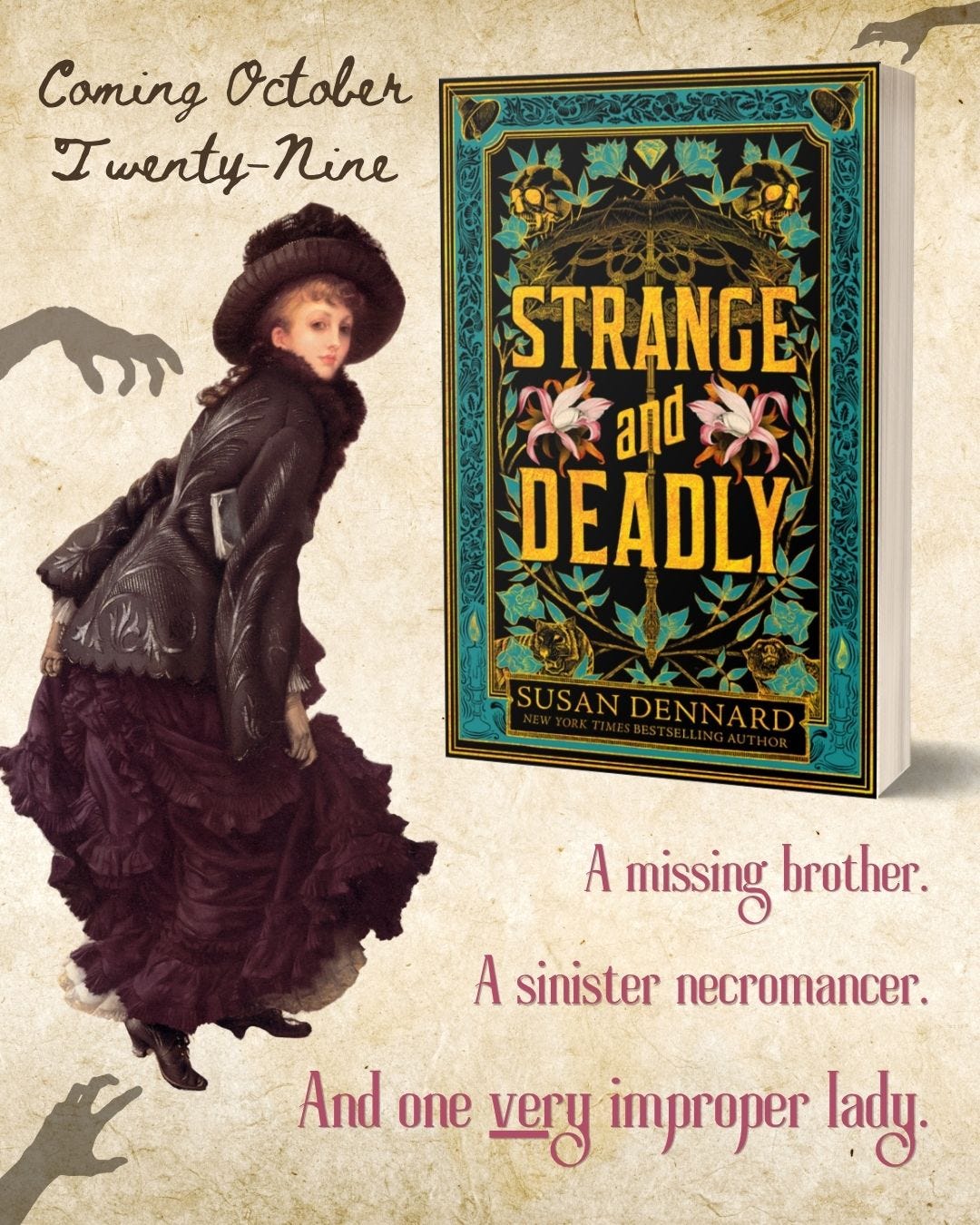
First off, in case you missed it, I revealed the cover for Strange & Deadly over on Instagram and in my fan newsletter! Woohoo!

The book releases in only 8 (!!!!) days, and I hope you all will consider supporting me with an ebook buy when it comes out. ☺️
Now onto the answers for our AMA. This is just part 1, since—unsurprisingly—it took me a while to fully answer the questions in my rambling-Sooz way.
I’ve got a transcript below, if you don’t want to watch or listen.
And if any of you have follow-up questions, please feel free to leave a comment. Or if you have new, unrelated questions, then go back to the original AMA post.
Now onward to the transcript, and thanks for being a subscriber!
Transcript:
Hi everybody, ‘tis I, Susan. It’s been a while since I did a video, and especially on here. And yeah, I just thought that this would be maybe the easiest and most interesting way to do that: answer the AMA questions versus writing out long posts—or just doing an audio recording. I thought you all might want to see me, and if you don’t, well, you can just listen or read the transcript. So there we go.
As you all know, I did an ask me anything, AMA…What day did I do that? The 12th, and today is the 19th. A week ago, a week ago exactly. And as I expected, I got a lot of questions about self-publishing and sort of why I made these, the choice that I’m making, what I’ve done, and I will do my best to answer that, and also to direct you elsewhere when I don’t have the answer.
And then I got some questions about some assorted sort of creative life, attitude, mindset questions, and I will get to those. And then of course there’s some fun gaming questions, and then a few sort of Witchlands questions.
So, I’m gonna start with the self-publishing Strange & Deadly questions, just because that’s probably gonna take me the longest. We’ll see how far I get, because I will probably have to do this, just based on timing and where I have to be today, I’ll probably have to split this in half.
So let’s start with part one: all of your self-publishing slash Strange & Deadly slash traditional publishing questions and why I’m making the choice I made.***
So first one up we have from Taylor. Taylor asks,
“I’m not sure how re-releasing a book whose rights have reverted works. So please bear with me. Was there a trad option to releasing the new version? If so, what were your reasons to pursue going hybrid?
So, I got my rights back for Strange & Deadly in 2023. The book actually released in 2012, so it was a long time. And it was HarperCollins, my original publisher. They were actually really great about giving them back to me, even though I wasn’t even technically quite selling under the threshold requirements, a lot of the threshold requirements were made before e-books existed or e-books were a thing, and so when they said you need to sell under 250 copies a year in order to get your rights back, well, it’s a lot harder to do that now in the age of e-books, where you can continue to churn out that many a year pretty easily, but you’re not selling any physical copies. So all of that is to say, they were very kind, and they gave me the rights back.
And I thought at the time, the plan for a while was that I would just sort of maybe do a light edit, a sensitivity read kind of thing, and then put the put them up on KU and just sort of see what happened, you know. Put them out there for readers who wanted to read my debut work, and otherwise just leave it be.
Well, with that plan in mind, I went into last fall giving them, I was talking to my agent about it, and she and I came up with this plan to do that, and we were doing all this research and setting all that up behind the scenes-ish. It wasn’t like a. It should not take that long. The reason it took that long is this was not in any way a priority for either of us.
And so finally, in around March, I had gotten some feedback from an editor to sort of edit it and bring it into the modern age just a little bit, lightly. When I was sitting down to edit, based on her notes, my own, you know, growth as writer, what I would see when I opened up the book, and yeah, and I opened up the book and read that first line, which is open quote dead. It’s the dead. I’m not even sure it’s that whole sentence. I think it’s dead. A woman cried. It’s the dead. Something like that. I didn’t like it. I never liked that opening line.
And the only reason it was the opening line was because back in the 2010, when I was editing it with my very first editor, who did not actually stay on as my editor for very long. She changed companies before that book ever came out, she felt we should open in medias res, you know, in the middle of the action. So, you know, I didn’t have my own instincts yet, and I did what she wanted, which isn’t to fault her, to be clear. It just wasn’t ever really my way of actually opening a book.
So immediately, I was like, “Oh, great! This is a chance to rectify that. I’ll just change the opening line. Oh, but the second line’s not very good either. Oh gosh, the third line’s terrible. Oh my, this whole first page is just really bad. This is not how I show emotion. That was the big thing that I kept running into as I was reading. I don’t show emotion this way. It’s what I would actually qualify as telling now instead of showing, and so by page eight, I had rewritten every single word. I was working in track changes, and the whole thing was just red. I had not saved anything, so I was like, okay, this is silly. I’m not even gonna work in track changes anymore. I’m just gonna transfer it over to Scrivener and start working there. Well, by the end of chapter two, I wasn’t even sticking to the original plot anymore, so I was like, “Hmm, perhaps ‘tis time to accept the story is changing.
And I wrote this in the author’s note, but I’ll share it with you guys too. I remember sitting in my daughter in my car while I was waiting on my daughter at ballet, and I was like, “Am I gonna rewrite this entire book? We had a plan. The plan was to self-publish it, just throw it back up there, not do anything, no work for me. I have four books due with HarperCollins. What am I doing? Am I gonna rewrite this? And yes, I did.
I can’t. If I can see a better way to do something, I can’t leave it. It is for those of you who know CliftonStrengths. I’m number two Restorative. If I see a problem that can be fixed, I can’t not fix it. So I did. I wrote an entirely new book.
I think it’s awesome. I love the book, but because the plan had always been the reason for that long story, because the plan had always been to self-publish, I decided to stay that course. I’ve been wanting to experiment with self-publishing for a while.
I know traditional very well. I’ve been in the traditional industry for 16, 17 years. No, 16 years. I wrote the book 17 years ago. 16 years. I sold in 2010. So I’m very intimately familiar with this, and there has actually there have been times in my career where I almost went indie, but then some sort of circumstance conspired against me, or I managed to sell a book I didn’t think would sell. But this time it was no, doing the thing.
I’ve wanted to learn how to fish for a while. I’m going to teach myself to fish, and we’re doing this. So that was the choice that I made. I never even considered giving it again to traditional, which isn’t to say that I wouldn’t. I wouldn’t like in foreign markets. I would still be open to that, but the U.S. We’re going hybrid. Well, for this, my career will be hybrid, but this book will be indie all the way. So those were my reasons.
Next question from Taylor says, “How do you feel your experiences differed from your previous trad experiences?
Well, there’s no advance. That’s number one, right? I have no money coming in. I had saved up for this from past advances because I actually always one day I wanted to go indie, so I have been saving money for that eventuality so that I could do this the right way, so to speak, and try to mimic my own traditional experience as much as possible.
So I hired a cover designer who is, as far as I know, has only worked in traditional. And wow, did an incredible job, but it was very expensive, right? I know that there are more affordable options out there, but I chose to go this route on purpose, and it’s a big expense upfront. Those sorts of things that my publisher would pay for, I had to pay for when it comes to advertising. I had to pay for that in a way that I wouldn’t have had to in the past. But yeah, the that I’m not even to that point yet.
The main thing that has differed so far is that I am both in charge and in control of everything. I just figured out what I wanted for the cover. I found the artist. I hired him and worked with him and gave him my exact feedback, and he executed it beautifully.
I. I typeset the book, right? So normally, I would get send off my book, and it hits copy edits, and the copy editor turns it into a format that the typesetter can read. And then I get it in pass pages. I see what it looks like. I hope it looks good. I don’t really get to decide. I mean, I can make some small tweaks here and there, but I don’t. It costs them money every time they retype set it. You reflow it. It’s what it’s called, and so you can’t do a whole lot of pass pages.
Whereas for me, even though it’s pain in the butt, and I did do it, if I decided to change something in after later, literally, I was catching still a typo today. There was a missing space I noticed. I can fix that myself because I did all the typesetting.
I used InDesign, which is Adobe product, and the only reason I went with that, for those of you wondering, versus the much easier to use Vellum, is because for those of you who’ve read my books, you know I love some found footage. I love to have documents, newspapers, transcripts, letters, clips from books, and all that. And so there were just so many different found footage formats that I wanted to have. And Vellum is not very flexible in that way, so I needed to go pull out the big guns, work with InDesign, taught myself how to do that, and that was its own process, right? I had to learn how to use the software,
so it’s all these things that, on the one hand, it’s really awesome. I had such granular control. The book looks exactly like I want it to look. I wish I had a printout right here. I’m looking around, I might have a printout, but I don’t. Of course not. I’m not prepared.
You’ll see it soon enough, right? The book is going to come out in 10 days when I’m recording this. Nine days, hopefully, from when I post this.
So, yeah, I had to typeset it. I had to figure out how to make from there a reflowable EPUB and what all that means. I had to write my back matter. I had to get a copyright, right? All these things that the publisher handles for you, typically, I had to do myself, and it’s not. It’s both been more work than I anticipated, and not like I have enjoyed having control. Again, to go back to my CliftonStrengths, number two Restorative. Really like to learn things, problem solve, make it the best it can be, and so I really liked having that control so far.
But there is no one to blame if things are messed up, if there is an issue with the typesetting. I know that there was one page in the paperback where the lines don’t line up at the bottom perfectly. I could not, no matter what I changed with the tracking, even with the actual words I added or took away, I could not get it. So it’s one line off. Normally, you want your paperbacks to line up perfectly at the bottom, or your physical copies couldn’t get it. One line, whole book, every other page works. So that kind of thing. That’s on me. I can’t. I can’t blame anyone. If there is an issue in terms of actual rollout next week, no one to blame but me.
You know, in the past I’ve had issues where books didn’t leave the warehouse, so they didn’t reach stores the first week, or while I was even on tour. That happened with Sightwitch. I was on tour and it was like, cool. I don’t have any books to sign. It happens, and I could, I didn’t blame my publisher, but I could just say, you know, this is life, warehouse problem, publisher, whatever. At that, for that, that was actually a Barnes and Noble warehouse issue.
I don’t have anyone here. It’s just me, c’est moi, c’etait moi. It was me. If it if it goes wrong, you’ll have you’ll have to come to me and say, Sooz, we’re so mad. So that will be interesting. We’ll see how that goes. There is more control, but also more at stake, I suppose. And again, since I’m not getting paid, it’s all out of pocket for me. The costs of all of this stuff. So we shall see.
I was thinking, and I will put this in the show notes so that people just know in case they don’t listen this far, I will do some follow-up videos probably, or just posts talking about everything, how the rollout goes, what I learn. Again, the difference between traditional, my traditional public publishing experiences, and this, which is technically my adult debut.
Wow! And normally in publishing, you would make your adult debut a really big moment. It’s a big deal. And instead, I’m hopefully not squandering it on this quieter release. But I’m excited. I’m excited. It feels very full circle. It is the first book I wrote, except a completely new take on it with 17 years of experience under my belt, and ultimately it did end up being becoming a completely different story, because even though I tried to always, I tried so hard to use at least the same some of the same big locations from the original, just in case there are any fans who were reading it who would be like, oh yeah, there’s the Dynamite Factory, but I’m a better writer.
Back then, I would make the characters do things for the sake of the plot, and now I cannot do that. The plot can only come from the character and the choices that they would logically make based on their needs and their motivation. And so, I couldn’t always find reasons for my characters to go to places that they did back then in the original.
And definitely, things happen in a different order. But I’m excited for anyone who is familiar with the first series. You’re gonna be like, “Whoa, this is similar but so different. And anyone who doesn’t remember it is gonna be like, “Oh, same vibes, same character names. Sure, maybe it’s the same. I don’t remember. Hopefully, either way, you have fun.
Okay, next question. See, this was why I was like, “This is gonna take at least two videos, because I ramble.
What am I most excited about for this release? This is still Taylor’s question.
I am really excited about this book. I just I had so much fun writing it, and I’m just, I think it’s really fun. And that has actually been the number one sort of feedback comment from readers so far, it’s just really fun. So I hope you read it and you’re just like, wow, that was such a fun time. It got a little spooky at times, or a little dark and intense because it is, you know, necromancy and zombies and stuff. But it never stopped being fun. And Eleanor as a character, I just think she’s a delight. I enjoy being in her head. She’s nothing like me. I wish that I was like her. She’s nothing like me.
Okay, Taylor, you had another question, but I’m gonna save that for when I talk about creative life stuff.
All right, next up, Katt has asked: setting up your own publishing company, how hard is it? Katt with 2t’s, not hard at all.
It really depends on how intense you want to go, right? Some people set up LLCs in order to and separate bank accounts in order to give themselves liability protection and/or just to keep things organized.
Other people just throw up a book and put it out there, KDP is not hard to set up. I’m also going to be distributing through IngramSpark, and full disclosure, my agency is helping me with that just because they have a lot of experience with the stuff, and so they are also helping me. So I’m not totally solo as I figure my way through this, but I have also done a lot to educate myself.
I took a fantastic, very intense. I mean, I cannot believe she gives you so much information. It seems like a lot of money, but it is not given the volumes of content you get. I mean, it walks you from beginning to end, and that is Sarah Cannon’s Publish & Thrive course. Highly recommend. Highly recommend. Sarah’s fantastic.
From just anything, anytime I see her online, anything she’s ever put out, she does the HB 90 planning, which I use that planner still. I never actually took the course, but I use her planner all the time. I find it very helpful for my scattered brain who doesn’t like to. I don’t like to plan everything daily, as you all know. I have the journey, but it does help me sort of lock in on how long things might take, and realistically versus Susan’s positivity, always optimistic [C1] outlook, which I never seem to actually succeed with. Sure, that’ll take me a week, she says. Then three weeks later, they is when they actually get it. So yeah, Sarah Cannon, Publish & Thrive. Highly, highly recommend.
But if you don’t want to spend the money, I totally understand. All of this information is out there. Indies are so generous with sharing how to do things. So just a Google search is going to give you so much information. And yes, you do have to wonder, do you trust? But I think you can tell. You know, we’ve all gotten pretty savvy, right, in today’s age at telling who’s legit and who’s not. So you can decide.
Yeah. All right. So not that hard to set up company. You don’t need to set up a company. You can just publish it as yourself. It really just depends on how complicated you want it to be. There you go. I have an LLC, but I have an LLC anyway because I have this Substack. I have my academy. I just for bank account purposes, it flows through that. It’s just easier for me, but you don’t. You don’t need to do that. You really don’t.
Okay. Next question. I’m not used to talking this much. Oh, all at once. My voice is getting shot. Such a weakling.
All right, Sarah. Hello, Sarah.
Exciting. I would love so much to know how to even get started in self-publishing. One of my biggest challenges is that I do not have much of a social media presence, and I don’t know how to build one. I see you, girl. Love writing, but I greatly dislike much of what social media has become. Mm-hmm. Mm-hmm. Substack is one of the few platforms I still engage with, and even then, I’m fairly limited. Learning how to handle that aspect of self-marketing would be hugely helpful. And seconding the negative energy, this was in response to Taylor’s other question. It’s the worst time to be a debut. Get offline.
It’s true. It’s true. I will repeat that when I do the creative writing advice here. I’m gonna make a little note. I color coded my question, so I’ll make sure I put the blue next to that one so I repeat it again. But yes, okay, Sarah.
Again, like I said for Cat, Google’s your best friend right now. If you even want to know how to get started, I think it can seem really overwhelming because there’s so much you have to do yourself and so much you have to think of, and there’s so many things I didn’t think of.
So for example, I have this amazing cover, and initially when it was just going to be something Strange & Deadly, the original trilogy that I was throwing back up on Kindle, I was just going to throw it in KU. I need a cover for that, but I wasn’t going to do paperbacks or anything. I was just going to throw it up in KU, see what it did. But now, because I wrote a new book and I’m very invested in it, I’m really proud of it, and I think my current readers would just really love it because it’s such a Susan Dennard book. If you like Susan Dennard books in the last five years, last 10 years, you’re gonna love this one. I wanted to do a paperback.
Well, for a paperback, you need a full jacket because it’s printed right, it has to have a back cover and a spine. I didn’t think of this, duh, duh. But I didn’t think of it, and so that was one of those things that’s just today, literally today, I got the final jacket. So even then, I think I’m gonna have to make a few tweaks on my own.
Which is one of the things too to go back to costs and things. I had to pay for, make sure you pay for the full commercial license and that you own what you get because then I can modify and mess with it. So for example too, I’ve made I’ve animated the cover in Adobe After Effects because I just I love doing that. I’ve been a long time Adobe After Effects and Premiere user, and so this is a fun. It’s the perfect cover to pull apart and animate. So I animated the bells and the candle, and I couldn’t have done that, right? You have to have the right kind of license to do that with art. And so for me though, because I bought the whole thing and I paid that money. I can do that. So that’s just a side note to consider.
Going back to costs, but things also that I didn’t think of: the jacket copy. Oops. Hey, Leo, dude. I need a full covered spine. Everything. Can you do that? And he can. And of course, he had to charge me more. But yeah, I just got it today, and I’m like, oh, this book comes out in 10 days. Phew, thank God, we got that in time. Hopefully, I can get that, the paperback probably a few days later than the ebook, depending on how long Amazon and IngramSpark take to process and approve me. We’ll see. Fingers crossed, it’s not too long.
So yeah, there’s just a lot of things that you don’t think of, and so, and I think it could seem really overwhelming, but take it one thing at a time, right? First, first and foremost, you need a book. You need a finished book. Second, you need an edited book. I urge people to work with professional editors, but of course, not all editors are made equally, so oh wait just a second.
I’m back. Sorry about that. My phone, because I get really in the zone on things and I lose track of time. I have alarms set to remind me to pick up my kid from school, so it’s about to go off. But don’t worry, I have time. She does after school program, so we’re good for now.
Okay, where was I? Editors-they’re not all made equally, so these are the sorts of things you need to sort of figure out on your own.
I am someone who would hire someone I know who’s probably worked in traditional just because that’s what I’m used to, but that’s also going to be really expensive. You know, they charge a whole lot of money, and we all have budgets, so I understand not. I understand people skimping there and not skimping is the wrong word, but I understand people not using editors, and you know, to each their own. That’s totally up to you. But if I was going to spend for me, if the number one cost would be in that editorial space, especially if it’s my first book or early in my career.
At this point, I’ve published 14 books. Two more are coming out in the next year, so they’re already done. So that means 16 through you know with editors with publishers. Two more after that already lined up with HarperCollins that are mostly written. I have a Strange & Deadly book this year, so that’s 18, 19 books, and there’s still more on my hard drive that I finished. So I feel pretty confident in my own editorial skills. But even then, I think it’s really important to have other people read and critique and give you thorough, rigorous feedback.
So just all this is to say, there’s a lot of steps, a lot of things you need to do. You get your editor, you get it edited, and once you’ve got that, then what do you? What’s next, right? And
I, I am not gonna reinvent the wheel when there are a million again people out there teaching this and have checklists for you to look at, so Google it, find that, and just remember, it might seem like a lot, but it’s one thing at a time, just one thing at a time. And a lot of this stuff doesn’t actually take that long. Setting up a KDP account, Kindle for Kindle, for Amazon doesn’t take that long. But then, meanwhile, working with a cover artist could take a while, depending on their workflow. So there’s things you just-it might seem like a lot. Some are bigger, some are smaller, some are more expensive. It’s just kind of up to you to go along with it.
And then your question about social media presence-I mean, I have zero social media presence now, but obviously, I built a following before social media became a horrific hellscape.
I back on Twitter was Twitter, and it was super fun. I really, I loved Twitter. I built a really great following there, and then, Twitter became X and then early days of Instagram. You know, they would show your posts to the people who actually followed you instead of caring about this algorithm and pushing you toward video and all of that, which is just not for me. So and.
Now, I have not budged. I’ve stayed at 33,000, 34,000, just kind of waffles up and down for years. And admittedly, I am not on at all anymore. But last year I was. Last year I would install the app pretty much every day or every other day. Post and delete the app again, and maybe it knew that, so it penalized me. But I had posts that would go viral. I had one that got two and a half million views, and guess what happened. I didn’t sell more books, and instead I just got inundated with bot follows.
Sorry, but no, that is not what I’m here for. So all of this is to say that I support you not being on social media. I don’t think you need to be on social media. If you like Substack, then I actually think that’s a good place to be.
People do engage here, and I still believe in the power of a newsletter. People have given you their email for a reason, and admittedly, it’s not quite like a newsletter on Substack because people do-it’s-it’s lower cost to sign up and follow someone, especially if you have an account and you’re already logged in. All you have to do is kind of click follow or click subscribe, and so people tend to subscribe and follow more often. And then after a post or two where they’re like, “Never mind, this isn’t what I came here for. I liked that one thing she did, but she doesn’t do much of that. They unsubscribe, but I still Most people are subscribing to you because they want to get information from you, and unlike Instagram, where they can follow you, they’re not going to see your posts. At least in Substack, you know they’ve subscribed, and that information, your emails are going to land in their inbox, and hopefully they’ll read them. So I think that’s good. Stay here, go for it. Build up, build up a Substack following.
Just be aware. So, I have two newsletters, right? I split my writing advice from my books because what I was finding is no shade on you guys. No one on my writing advice newsletter was buying my books.
Well, it used to be that I had one. They were one, and I had a lot of lot of subscribers, certainly compared to most people’s newsletters. But they just weren’t converting to sales, and I realized I would be better served splitting because the people who are here for writing advice don’t care about my books. Alas, I wish you did. It would be great. It would help me feed my kid. It would help me not be so nervous about this release next week. But such is life. And instead, the people who wanted my book stuff were this group. So I split the two.
I try not to talk too much about my books over here because I people don’t want to hear it; they unsubscribe. So, just give you free writing advice instead, and yeah. And then the fans who want the writing stuff, the non writing stuff, who want just the book stuff, they’re over there.
So I would just be aware of that. If you’re gonna talk about X, then when it comes time to sell your book, that’s about why people might not want it, and they may not convert to sales. So just be careful about the content that you put out there and how it aligns with your book. And I have I’ve have this with friends who are influencers in some way, and yet they can’t seem to get those people to convert to their books because people come to them for maybe I don’t know fashion or hot takes, and then their book is, you know, I’m trying to think of some random genre, and all I can think of is my own genre. So we’ll just say a Gilded Age romp through Philadelphia with zombies, and people don’t want it. So understandable.
Next question that is on this subject. Lots and lots and lots about world building or writing, and some about creative life. And here we go.
Some practical questions that I’ve always wondered about for self-publishing. How do you actually do it? See earlier questions and answers for details. Do you only have e-books available, or will you have printed copies? And how do you get printed copies? Where do you sell printed copies in our e-books? How do you get them to be available for purchase? And can your book be picked up by a library?
Okay, so this is one of those things that I think is really commonly misunderstood in traditional publishing, I have a sales team, right? Whose job it is is to go to bookstores and be like, “Yo, you know Susan Dennard, do you guys know you liked that last book from her? She’s got another one coming. Don’t you want it? You should stock it in your store. And so the stores who can be like, “You know, we have sold a lot of her books. We will stock more of her books. Thanks for letting us know. Or they might be like, you know, she’s not selling that well here, but give me an early copy, and we, I, the bookseller, will decide if I think my store audience would like it. Or they just might be like, no, sorry, I don’t even know who that is. No, not.
And so I have a sales rep, and that sales rep—they are not just one, but many. They go all around the country, and they are selling books, pitching it to bookstores on behalf of the publisher.
If you’re an indie author, you don’t have that, right? And so it’s really going to be down to personal relationships and going to bookstores, and if you know if you have some evidence, if there’s some evidence, like you have sold a lot of books in the past, and they can see that number if they look at something where they can see your sales somewhere, then they might say, yeah, you know, we’ll stock you or your local author. You know, I’ve people love to not always, but especially in a small town or something, indie stores are usually willing to, or often willing to support indie authors.
They might be willing to buy a copy or two of your book to put on the shelf. But you cannot expect your book to be in every store. You certainly can’t expect it to be in every Barnes and Noble. My book sure ain’t in every Barnes and Noble. And Barnes and Noble has been very supportive of me in my career. I owe a lot to them as a company and a bookstore. So, but that doesn’t matter, right? They stock and they distribute based on where they think the book’s going to sell. It doesn’t matter who you are. It just is. It’s a business choice.
So I see people getting upset because an indie bookstore won’t stock their indie book, but the two aren’t. They have to make money. Books don’t make very much money. It’s very low profit margin. So unless there’s some really clear evidence or reason for them to do it, that’s their choice.
If they want to stock your book, though, then the best way to do that is to have your book. As far as I’m aware, if there are indie authors watching this who have alternative approaches, please, I would love to know them. But my understanding is the best way to do that is to go through IngramSpark, and IngramSpark is where then the indie bookstores can get on and see, oh, look at that, you’ve got, you do have your book, and I can order you know copies for the store, and I, I think the same is true. You know what? Let me check this before I say it. Yes, I was right. Just wanted to make sure. Yes, libraries are same, same thing. IngramSpark. They can look in the IngramSpark. But same as with an indie store, they may not. They may not want to stock your book. They have limited budgets. Are they going to want to spend their money on your book? So don’t be offended if they don’t, they don’t just take it or buy it or whatnot. Put it on their shelves, because also too in traditional, I have library, I have a school library team, I have a team that goes to libraries and pitches my books to librarians and really nurtures those relationships so that the librarians and there’s also publications, right, that have reviews. So a library might get Booklist or School Library Journal, and they can read the reviews and say, yeah, that’s a good fit for my school or not, or that yeah, that’s good fit for my library or not.
So there are places in the traditional world that naturally it’s an ecosystem that’s very well established, and that’s not to say that that doesn’t exist yet in indie, but it’s not like that yet. I think it’s growing and changing because indie is really dominating these days, so that will become more and more common. And I think, from my understanding, is IngramSpark does make you make it easier to make those connections, and certainly if they do decide to stock or put your book on shelves, be it a library or store, they can do that.
The printed copies, like what I’m doing for print, is what a lot of people do, which is just print on demand. So Amazon, Barnes and Noble Press—or B&N Press, I guess is what they’re called—and IngramSpark all do print on demand, so somebody orders it, it is printed in the moment and sent. But they also each take a cut because that costs money, right? And so you just have to think about those costs. I don’t actually, I’m sure it exists, but I don’t know anybody who prints ahead of time, not for paperback anyway. Hardcover is different, which I’m not doing at this point. But maybe one day down the road, if there was an interest or a reason. But for now, I’m just doing ebook and paperback. And it is. Don’t forget to have a jacket, a full jacket. But other than that, it is. They make it pretty seamless and easy to do.
All right. What do I miss most about being a trad pub author? I am not leaving traditional, so I don’t have to answer that. Nothing. I still have four more books coming with HarperCollins, and hopefully I will sell them more. So, or if not them, someone else. I can. I plan to continue to traditionally publish in the YA space because I really need that distribution connection and library and school connection, which I don’t feel like I can get on my own. I know I can’t, and I just if I want to continue to be you know in the right schools and libraries and on state lists and things like that, which also helps with exposure. A lot of libraries will look at their state list to see what to stock. I yeah, I’m going to continue to stay in traditional for that, and who knows, maybe do all of my adults in indie. We’ll see how this experiment goes.
And what am I most scared of? What was I most scared of before I started? I don’t know. I don’t. I wasn’t scared before I started. Before I started, all I saw was possibility. Now I’m getting nervous.
Are people going to show up and buy it next week? Am I going to earn my money back? That would definitely be my main goal. Can I just break even, at the very least? And to be clear, I haven’t spent reams of money. I don’t have ream. I don’t have reams of money to spend, but I have put more on the line than I certainly have for any past book, pretty much.
So I just would like to make my money back at break even, and then most I guess I have the same fear that I would have with any book, which is I hope people like it. I think it’s really fun. I loved writing it, and so whenever people are disappointed in a book, I take it personally. Not, not as an like a. I mean, yeah, I do feel sort of like I failed, but I mostly just feel like terrible that I let people down. If it doesn’t, if they don’t have as much fun as I thought they would, I always feel like I have failed them in some way, and I don’t like that feeling. It’s not a nice feeling.
So, yeah, I hope you enjoy it as much as I enjoyed writing it, and that you do take you know for the however long you spend reading it, that readers come away like, Wow that was awesome, and not like Damn, Sooz. I’m never reading another book by you, but we’ll see. We’ll see very soon.
Next question about self-publishing. I have been talking for quite a while already. See, I knew this would happen.
Oh wow! As someone in the midst, this is Becky, of trying to figuring out how to self-publish, self-republish a YA fantasy series which sold poorly originally. I understand. I just got the rights back too. I have so many questions. I wish I could just ride along and watch everything you do….
(I will actually, like I said, try to give as much of lessons learned before after. Here’s what I figured out here’s what I did differently, so you can sort of sit on my shoulder and watch.)
…which platforms are you looking at selling.
I’m doing right now, I’m doing KDP Kindle for ebook and so KDP, which is Amazon for ebook and print on demand, Barnes & Noble ebook and print on demand, and then I’m going through IngramSpark for everything else. That might change. The nice thing is that it seems like you can just toggle things off and on. If I find, oh my gosh, people on Kobo love my book, and I don’t want to lose a cut of my Kobo income to IngramSpark, I can turn it off on IngramSpark and set it up on Kobo instead. Maybe I’m still figuring this out. See,
I and you can go, you can be on Amazon and go wide. It’s just the question of if you’re in KU, Kindle Unlimited. Although my understanding is you can pitch to Kindle Unlimited, and they might accept you in. That’s certainly how it works with traditional, right? Because the Witchlands is in KU. Read them all now if you’d like. Entire series in KU, but it also is sold widely. So my understanding is you can pitch them, but you might not be accepted. So we’ll see. But for now, I’m not planning to be in KU. I might eventually because the Witchlands has actually done decently well in KU, and it would be nice to capitalize on that.
Number two from Becky. Does my marketing and strategy change at all for self-pub compared to what I do in trad pub? Not really.
I make graphics. I deliver the information to my fans on my newsletter, predominantly, but also on Instagram. Make some reels. I love making reels. I mean, I don’t like reels. I like making videos. I like editing videos. I’ve been doing it since I was in college. I feel like if I hadn’t become a writer, I would have become a music video edit, like director or something. Not even the director. I just want to edit the footage. So yeah, I like that part, but I’m not really doing anything differently. The big thing that will be different is that I will be doing my own ads. So we’ll see how that goes.
I’ve run some ads before, like for the academy. It can be effective, but it does require a lot of management. So we’ll see. But I do think ads are pretty important when you’re indie published. So if you’re not into that, then that’s you know something to consider a point in traditional’s favor, I suppose. So yeah, I’m gonna be running ads. We’ll see how that goes. It’ll be a learning experience for sure. That’s really the only difference. Yeah.
Okay, I’m about. This is from Shante. I’m about to indie pub my 10th book in three years. Dang! Look at you. I’m impressed. I love being indie. I hope you will as well. Thank you. With that said, I’ve been considering making the leap to hybrid, but I’m a control freak and have had mixed experiences working experiences working with audio publishers and foreign publishers. So I’d love to know your favorite parts of being a true author. And do you think it’s better or easier to sell all of your rights to a book, or better to sell only certain rights like print?
Yeah, don’t sell all your rights. No. And anyone who tries to get, I mean, most publishers, traditional publishers, are gonna want print and ebook because that’s just standard. But I am seeing more and more indie authors only negotiate print rights. So do that for sure. Don’t tell them I told you that; they’re gonna hate me. But do that for sure if you can. But other all the other rights, the only you can do audio if they do audio. So HarperCollins does my audio and my Print slash ebook for the upcoming Murder Quartet. Tor did audio for one of my series. They did my ebooks as well—or not ebooks, my audio books. I sold them the rights to that as well, but not for the Witchlands. We sold those separately, so it just depends on if you want to sell them your audio rights or not.
What else? do I think it’s do do? Also, I love to hear how the YA market has changed since the pandemic. Oh man, okay, we’ll save that question for when I talk about creative life because it’s relevant to that. I’ll mark it with blue.
But yeah, I mean, look, I don’t know how easy. I don’t know your circumstances, so I don’t know how easy it is for you to get a traditional deal. There are certainly advantages to again going back to distribution. You have those channels, right, which can be really worth it, right? If you want to get into airports, you know, or Sam’s clubs; those are things that a traditional publisher can do for you. Maybe depends on the place, right? My Roomba had turned on. Let me turn that off, and I’m back. I will have to leave shortly to get my kid. Now, Roomba is my other alarm.
So, I think there are definitely advantages in that regard, but the markets are changing. Things are changing so much. If you really have (there goes my dog!) a big team and strong infrastructure in place already, some people are finding their own paths to that stuff.
It just depends on what you need. I do know many an author from indie who’s gone traditional and then really, really struggled with that lack of control, and it’s not even a lack of control; it’s a lack of transparency. I do not say this to disparage publishers in any way. I’m used to this. This is how it works. They don’t tell you anything, and you just kind of get used to it that you will never be part of the loop, or they will sugarcoat things where you’re like, I know that’s not why you’re really doing this. Just be honest with me, but they don’t. So
I can see it’s hard enough when you’re you’ve only been in traditional to deal with that stuff, to come from a place where you did have full control and you did understand the decision behind every choice you made to a place where you’re like, that doesn’t make any sense. Why would you do it this way? And you don’t get an answer, and you will never get an answer. That can be really hard. So I think it’s worth considering that, and talking to indie authors who’ve gone traditional and how that experience has gone for them, because it’s very different from a trad author going indie.
Yeah. All right. I need to hurry. So two more questions on left that I highlighted pink. So pink was for self-publishing Strange & Deadly questions. Okay,
Dom says hello. How did you find the typesetting process? In 2006, I used QuarkXPress 5, and whilst I didn’t make any mistakes, I don’t think my text was formatted properly. As for the cover, did you go for a specific design to prevent spine format issues where the spine itself didn’t match up with the width of the printed book. I’m guessing the ebook process is pretty straightforward. Anything else you found really difficult you’d like to share? Thank you.
All right, Dom. I think I mentioned this earlier. I used InDesign typesetting. It’s a lot, but there are so many walkthroughs on the internet on how to use it. I found it to be crunchy at first, and even still, I’m like, I don’t know how to do this. Google. But once I got the basics, and now I have a template set up for the Strange & Deadly series. So now when I it’s time for me to put in book two, I’ve already got everything set up the way I want it.
But you don’t even you don’t need to use InDesign. You don’t need to go that fancy or that complicated. Vellum, if you have a Mac, is very user friendly, very user friendly, and Atticus I think is the one for PC if you have Microsoft, so you don’t have to go difficult like I did. I made my life harder, and like I said too for the spine, I. When it comes to all these print-on-demand places, they give you a template. You have to put in your ISBN. They then put a barcode for your ISBN on the book template, and then for me, I gave that template to my cover designer, and he made the full spine with that template. So what he gave back to me matches exactly what I need to upload.
Anything? Oh, in the ebook process, yes, very straightforward. Especially if you don’t use InDesign and you use something else, which Vellum plays really nice at making you an ebook from and print version. Although you do, to print, you need the full software for Vellum, which is not a subscription, which is nice. It’s 200 and something dollars, 240 maybe, to get the print and ebook. If you’re only doing ebook, I think it’s much cheaper. I don’t, I don’t remember, but it’s a one-time fee versus my Adobe subscription, which they take out of my account every month. That’s a lot of money. Adds up real fast.
So yes, nothing else I found that difficult. The most difficult thing has definitely been the typesetting. So far, we’ll see once we release.
One more question from me. This is Dom again being sneaky. Did you use a pseudonym at all? And if you did, do you use your newsletter subscriber list from Substack to send emails about your new book.
No, I don’t have a pseudonym. I should have. If I could go back to 2009-, 2010-Sooz who sold her first book to HarperCollins when she was a bright-eyed 20-something. How old was I? 26. It’s like 20. Oh my God, 26-year-old. I’m trying to figure out if that math is right, but I’m pretty sure that math is right. Yes, 16 years ago.
I wanted the world to know Susan Dennard wrote this book. And if I could go back in time, I would not use my name. I would use a pseudonym for sure, for privacy reasons and just for protection reasons. And I didn’t see the internet turning into what the internet is today, so there are advantages to a pseudonym. If, but no, my name is Susan Dennard, and it is Susan Dennard on the Substack, and it is Susan Dennard online, and it’s Susan Dennard on my books.
So yeah, I think if you want to use a pseudonym, then start an online profile with that pseudonym. That’s what lots of people do, and then that is your online persona. That’s the name you use everywhere online, and it’s what’s on your books. So there we go.
All right, I believe that is the last of my indie-related questions, at least for now. I will come back because there are more questions. Not about this topic, topic though. I will come back with stuff about the writing, creative life, the challenges of that, and the publishing life. Some of you asked some awesome questions about gaming. Many thanks. I’m excited to answer those, and yeah, thank you for listening. Thank you for asking questions. If you have follow-up questions, feel free to put them in the comments here. That’s probably the easiest way for me to keep track of them. If you have new questions, the AMA is still technically open, so go throw them on there.
And yeah, Strange & Deadly is coming out in 10 days from this recording. I just released the cover. I’ll put the cover actually along with this video so you guys can see it because I’m really pleased with how it turned out. You know, I got what I paid for, and I paid for something beautiful. So it was it was worth the money to me, and I think it will just look fantastic once it’s in a bookstore. You’re scrolling by. I think it’s very eye catching, and it’ll look fantastic once I get a print on demand copy. We shall see. I don’t have it. I’ve never seen a physical copy before. It is fraught.
That is one thing I will say I’m struggling with is just the timeline. In traditional publishing, you finish your book, and then it’s like, all right, I’m gonna twiddle my thumbs for six months while I wait for the all of the stuff to happen behind the scenes. You know, the sales reps I mentioned, the school and library reps, the marketing team, the publicity team, all these people setting all that up.
You know, I’m in constant contact these days with my HarperCollins marketing and publicity person people. It’s two people, and then I’m sure they have people working under them. And it’s wonderful, it’s great. But that book doesn’t come out until the end of January. It’s months away, and I am in as much contact with them as I am with the people helping me do the self-publishing stuff.
So it’s an interesting. It’s interesting to see how short the timeline is. But I’m also excited about it. I it means I can finish writing this sequel because I’ve written a whole new sequel, of course. Too. It’s even more different from the original. I’m struggling even more to get back to those original. Set pieces of the second book than I did with book one. We’ll see. It might deviate significantly more in terms of locations. We’ll see, but it’ll be cool. I’ll be able to finish it, edit it, edit it, and then publish it. There’s no waiting.
So that will be very interesting. So, but that’s also stressful, right? Because I’m like, oh my god, there’s so much to do. Can we get it all done? Yes, I can get it all done. Lots of indie authors do this all the time. So it just seems like it’s a lot to do. But 10 days, 10 days. I hope you guys will support me.
And yeah, stay tuned for another AMA. I will try to get it out next week, but we’ll see if I can find time to record or not. But that’s my that’s my hope. Okay, bye! Thank you for listening. Thank you for subscribing. Thank you for being awesome.


